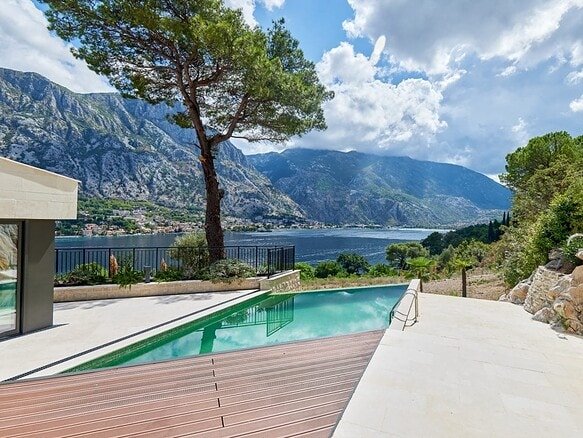

Montenegro operates a dedicated digital nomad residency permit that runs until 31 December 2026, offering remote workers and internationally mobile professionals up to four years of legal Adriatic residency with zero Montenegrin income tax on foreign earnings. For property buyers watching the country’s coastal market, this permit adds a dimension that purely investment-led analysis rarely captures: a structured route to spending extended time in Montenegro, learning the market firsthand, and acquiring property during a period when prices along the Bay of Kotor and the Budva Riviera remain positioned below comparable European coastal destinations.
The permit is worth understanding precisely because it is time-bound. No extension beyond 2026 has been confirmed. The window is open now.
What the Permit Actually Is
Montenegro’s digital nomad programme issues a Type D temporary residence permit rather than a traditional entry visa. The permit runs for two years with a single renewal available, giving qualifying applicants up to four years of legal residence in Montenegro. During that period, income earned from foreign employers or foreign clients is not subject to Montenegrin personal income tax. For high-earning remote professionals who would otherwise face substantially higher marginal rates in their home jurisdiction, this creates a fiscal environment worth taking seriously.
The income threshold stands at a minimum of approximately €2,010 per month in 2026, reflecting three times the national gross minimum wage. Applicants must demonstrate employment with a company registered outside Montenegro, ownership of a business incorporated abroad, or freelance work serving clients entirely outside the country. Working directly for Montenegrin clients or employers is not permitted under this status.
Required documentation follows a standard pattern: a valid passport, a clean criminal record (apostilled where required), private health insurance covering the full period, proof of accommodation in Montenegro, and bank statements evidencing consistent income at or above the threshold. The accommodation requirement can be satisfied by a rental contract or by property title deeds, which is relevant for buyers who acquire early in the process.
The Critical Limitation: Permanent Residency Does Not Follow
Time spent in Montenegro under the digital nomad permit does not count towards the five years of continuous legal residence required for permanent residency or the pathway to Montenegrin citizenship. The permit is treated as temporary in the legal sense, and applicants should plan accordingly if long-term settlement is their objective.
Those aiming for eventual permanent residence would typically need to transition to a residency category that does accrue towards the five-year threshold, whether through company formation and self-employment as a director, local employment, or the property-based route that requires a municipally-assessed value of at least €150,000. Our Montenegro residency by investment guide covers that pathway in detail. The retiring in Montenegro guide provides the broader framework for buyers considering a permanent or semi-permanent lifestyle transition.
What It Means for the Adriatic Coast’s Property Markets
Montenegro’s coastal towns serve distinct buyer profiles, and the digital nomad permit maps differently onto each.
Tivat, and Porto Montenegro in particular, draws the marina-oriented buyer: internationally mobile, capital-aware, and oriented towards branded residences and waterfront positioning. Our Tivat real estate market guide covers the pricing and yield dynamics of this segment in detail. Properties such as the Nikki Beach penthouse at Porto Montenegro and Boka Verde residences at Porto Montenegro represent the established premium segment here, attracting buyers for whom the marina lifestyle and international amenity base matter as much as the capital case.
Budva appeals to a different profile: buyers seeking higher entry-level yield potential alongside a functioning coastal tourist economy. The Budva real estate guide outlines this market in full. The Riviera Five Star seafront residences in Budva represent the direction the market is heading in the highest-quality new-build segment.
Kotor Bay, particularly the northern shore, attracts buyers prioritising historic character and maritime landscape over resort facilities. Kotor real estate has developed more slowly than Budva or Tivat, which is precisely its appeal for certain long-term buyer profiles. The full range of Montenegrin waterfront property across all three coastal markets provides useful comparative context.
How the Pieces Connect for Property Buyers
The commercial rationale for pairing the digital nomad permit with a property acquisition is clear. The permit requires proof of accommodation; owning property satisfies this cleanly. The permit gives up to four years of Adriatic living at low effective tax cost, during which the buyer learns the market from the inside, builds relationships with advisors and developers, and is positioned to make a considered acquisition when the right asset becomes available.
Montenegro’s coastal property market has matured substantially since 2020. Porto Montenegro has established a clear international benchmark, and the wider Bay of Kotor has seen growing interest from Western European and North American buyers. Prices remain below comparable Adriatic destinations on the Croatian coast, though the gap is narrowing in the premium segment. The nomad permit’s confirmed end date of December 2026 creates a specific planning horizon that buyers can structure around. Our broader Montenegro real estate investment guide covers the macro investment case in full.
The fiscal dimension reinforces the argument. Montenegrin personal income tax is among the lowest in Europe at a flat rate. For high-earning remote professionals, the combination of legal residence, foreign-income tax exemption under the nomad scheme, and meaningful coastal asset acquisition has attracted buyer profiles that the traditional investment visa narrative never reached. Full official requirements and the latest application process are documented at Wise’s Montenegro nomad visa guide, which is regularly updated as the programme evolves.
Barok Estates International is a premium, multi-location luxury real estate advisory operating across Europe and the Middle East.
Learn more about our advisory approach: barokestates.com/about
Explore our curated Montenegro portfolio: barokestates.com/listings
For confidential availability and consultation: barokestates.com/contact