
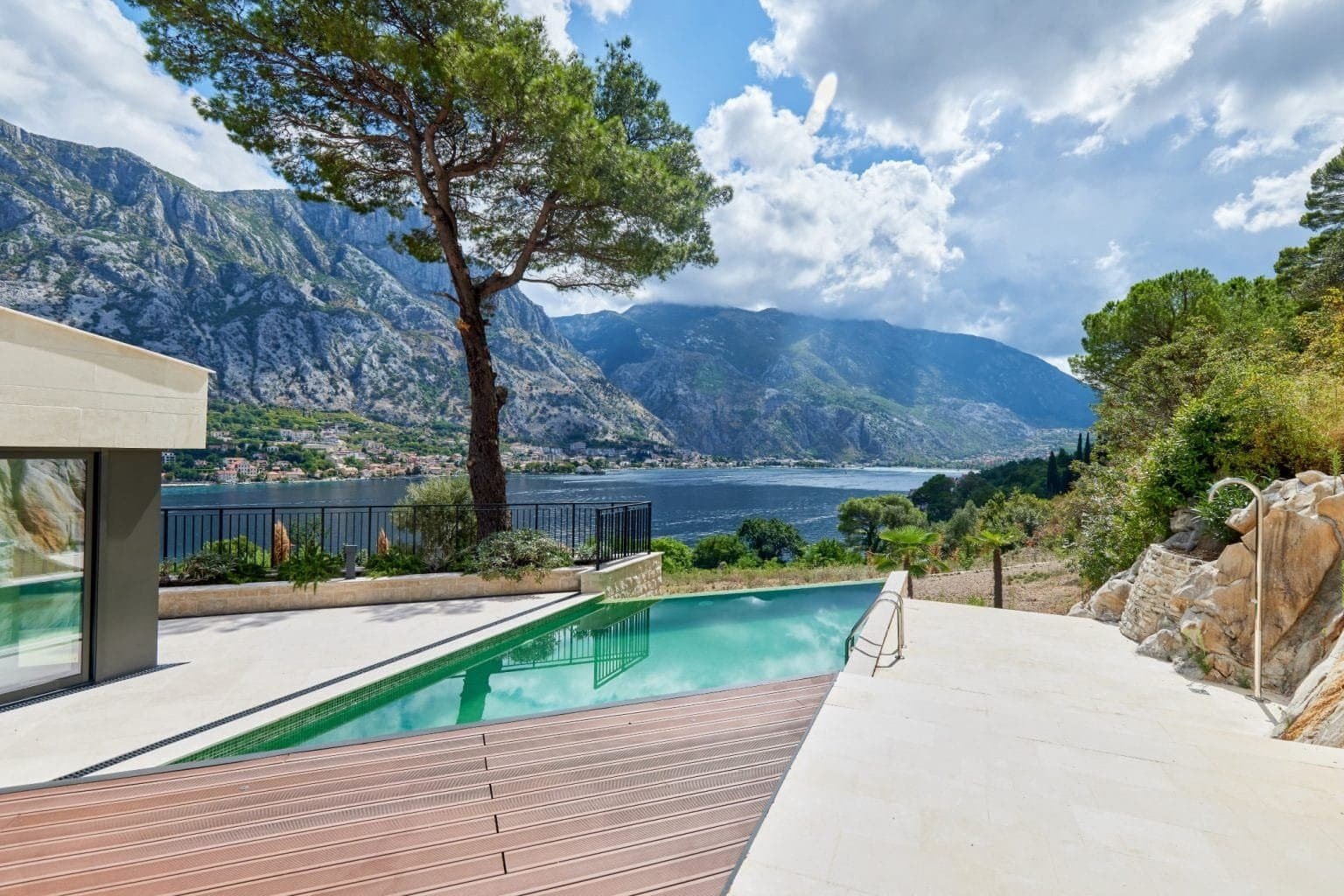
Perast real estate represents one of the most structurally constrained luxury property markets in the Adriatic. A UNESCO World Heritage listing protects this Baroque village of fewer than 350 permanent residents, sitting on the western shore of the Bay of Kotor, where heritage planning rules mean that supply cannot expand. For international buyers seeking capital preservation alongside Adriatic lifestyle, Perast real estate offers a rare combination: genuine scarcity, rising demand, and a price trajectory anchored in structural rather than speculative forces.
Why Perast Sits Apart
Montenegro’s coastline has attracted significant international capital over the past decade, but Perast occupies a category of its own within that story. The village is enclosed within a UNESCO World Heritage designation that covers the Natural and Culturo-Historical Region of Kotor, a status that imposes strict constraints on new construction and exterior alterations. Where other coastal towns can accommodate new development to meet rising demand, Perast cannot. The total inventory of historic stone properties in the village is fixed, and any property that comes to market does so against the backdrop of growing international interest and a supply base that cannot respond.
This structural scarcity distinguishes Perast property from the broader Montenegro coastal market in a meaningful way. The national average price stands at roughly €2,250 per square metre. Perast commands a clear premium above that figure. Montenegro coastal prices rose approximately 23 per cent year-on-year in Q3 2025, reflecting the depth of international buyer appetite across the Bay of Kotor as a whole, with heritage micro-markets leading that growth.
Property Types in Perast
The dominant property type in Perast is the historic stone palazzo or house: typically two to four storeys, built from local limestone, often with vaulted ceilings, stone staircases, and walled gardens or courtyard terraces. These properties range considerably in size and condition. Some have been subject to sympathetic restoration; others require full renovation, which is both an opportunity and a practical undertaking given the planning constraints imposed by heritage classification.
A smaller number of converted apartments within larger palazzos also trade, offering a lower entry point for buyers who want Perast real estate exposure without committing to a full-property renovation project. Truly prime assets, those with unobstructed sea frontage and direct water access, are rarely listed openly and tend to exchange through private advisory networks.
Across Bay of Kotor heritage zones, available stock is genuinely thin. Kotor Old Town presents a comparable heritage dynamic in terms of planning constraints, but Perast sits at a higher price per square metre, reflecting its exclusivity and smaller population base. Adjacent markets such as Porto Montenegro and Tivat real estate offer instructive contrasts: Porto Montenegro operates as a full-service marina development with predictable ownership structures; Perast occupies a different plane entirely, defined by heritage authenticity rather than new-build amenity.
Price Benchmarks for 2026
Current Perast property pricing broadly follows three tiers. Entry-level holdings, typically smaller units or second-line properties without direct sea views, are priced in the €420,000 to €500,000 range. These often represent partially renovated stone buildings where a buyer accepts some residual work in exchange for access at the lower end of the market.
Mid-range assets, the three- to four-bedroom stone houses with sea views and completed or near-completed renovation, sit between €500,000 and €900,000. This is the most actively traded segment for serious international buyers seeking Perast real estate with a balance of quality and relative accessibility.
Prime waterfront holdings, the trophy category with direct water access, exceptional provenance, or historic palazzo status, are priced from €900,000 to €2,000,000 and above. At the top of this range, values reflect scarcity above all else.
Per-square-metre pricing in Perast typically runs between €3,500 and €5,500, with prime waterfront property exceeding that upper figure. Compared with the Montenegrin national average of approximately €2,250 per square metre, the premium is substantial and well-supported by the supply dynamic.
The Investment Case
Beyond lifestyle, Montenegro real estate investment in heritage zones such as Perast offers a credible capital preservation argument. Gross rental yields in Bay of Kotor heritage locations run at approximately 5 to 6 per cent, driven by premium short-term letting in a market where the total number of viable rental properties is small and the category of visitor seeking them is high-spending.
The longer-term case rests on Montenegro’s EU accession trajectory. As the country advances through accession chapters, international institutional confidence and property demand are expected to strengthen. Buyers acquiring Perast real estate now are positioning ahead of a potential re-rating event that would bring Montenegrin property values closer to comparable EU coastal heritage markets.
The choice between Bay of Kotor versus Budva is a common buyer dilemma. Budva offers more liquidity and lower entry points; the Bay of Kotor, and Perast specifically, offers structural scarcity that Budva’s more developed market cannot replicate. For buyers whose primary concern is capital preservation and differentiated asset quality, the comparison resolves clearly in Perast’s favour.
Legal Framework and Purchase Costs
Foreigners can buy freehold property in Montenegro with no legal restrictions, and the acquisition process is straightforward with competent local legal representation.
The principal transaction cost is Montenegro’s progressive property transfer tax, applied to resale properties. The rate is 3 per cent on the first €150,000 of declared value. Between €150,000 and €500,000, the charge is €4,500 plus 5 per cent on the amount exceeding €150,000. Above €500,000, buyers pay €22,000 plus 6 per cent on the portion above €500,000. For new builds purchased directly from a developer, 21 per cent VAT applies in lieu of transfer tax, which materially affects the acquisition economics.
Beyond transfer tax, buyers should budget for notary fees, land registry charges, and legal advisory costs. Total Montenegro property purchase costs typically reach 10 to 12 per cent of the purchase price when all acquisition costs are aggregated. UK buyers acquiring property in Montenegro face no additional post-Brexit restrictions and follow the same freehold acquisition process as other international purchasers. Montenegrin residency options are a separate consideration for buyers who wish to establish a legal presence in the country following acquisition.
Perast Montenegro: A Considered Position
Perast real estate is not a broad market. It is a narrow, well-defined category of European heritage asset where serious capital competes for a fixed number of exceptional properties in one of the Mediterranean’s most protected coastal settings. Buyers who understand the supply constraint, the legal framework, and the pricing structure are well-placed to act decisively when the right asset presents. The nature of this market is that it does not correct in the way that larger, more liquid markets do. Properties in Perast Montenegro hold their value precisely because the conditions that make them rare are permanent by design.
Buyers who approach Perast property with clarity of purpose, defined criteria, and a realistic understanding of what the market offers tend to find their position. Those who arrive expecting volume and choice typically recalibrate quickly.


