
UK citizens can buy property in Montenegro freely, without restrictions on apartments, houses, or commercial units, and the post-Brexit reality has not changed that in any material way.
What has changed is the residency calculation. Before Brexit, British buyers in Montenegro were already non-EU visitors for the purposes of local property law. Montenegro, a non-EU state, has always treated all foreign nationals under the same framework. The distinction that matters most for UK buyers is not ownership rights, which remain straightforward, but the structure of how long they can stay, and how they convert ownership into a legal right of residence if that is part of the strategy.
For British capital looking at the Adriatic, Montenegro sits at an unusual intersection: accessible prices relative to comparable Mediterranean markets, a functioning property ownership framework for foreigners, a credible EU accession path, and a tax structure that competes favourably with most European alternatives. Understanding how that combination works specifically for UK buyers requires working through the details rather than relying on generalisations.
What UK Buyers Can and Cannot Purchase
The scope of purchasable real estate for UK nationals in Montenegro is broad. Apartments, houses, townhouses, and most commercial premises are available for direct purchase without requiring a local entity. The limitations that apply to all foreign nationals equally are relatively narrow.
Agricultural land cannot typically be purchased directly by foreign individuals. Land plots exceeding 5,000 square metres generally require acquisition through a Montenegrin registered company, a structure used by buyers wanting large plots for private estates or development projects. Certain zones designated as strategic or military are restricted, though these rarely intersect with the coastal residential areas where most international buyers focus.
For the overwhelming majority of UK buyers considering property in Tivat, the Bay of Kotor, or the Budva Riviera, direct purchase of apartments and villas presents no structural obstacles. The process follows a clear legal framework covered in detail in Barok Estates International’s guide to buying property in Montenegro.
The Residency Question for British Buyers
This is where UK buyers need to plan more carefully than they might have before Brexit, though the situation is more straightforward than it appears in much of the commentary around it.
Montenegro is not a Schengen country. Days spent in Montenegro do not count towards the 90-day Schengen limit that now applies to UK passport holders travelling in EU member states. For buyers splitting time between, say, Madrid and the Bay of Kotor, this is a structural advantage: the two countries’ allowances run independently.
As a visa-free destination, UK nationals can enter Montenegro for stays of up to 90 days within a 180-day period without any visa requirement. For buyers using a property primarily as a holiday home, that allowance is often sufficient without requiring any additional legal structure.
For buyers intending to spend more time in the country, or who want the legal security of formalised long-term status, property ownership provides a route to temporary residence. The threshold under current rules is a property valued at a minimum of €150,000, registered in the Real Estate Cadastre. A temporary residence permit based on ownership is typically granted for one year and renewed annually. It requires clean title, proof of ownership, proof of financial self-sufficiency, and health insurance. This is a workable structure for buyers who want to be in Montenegro for extended periods without becoming full tax residents.
A fuller breakdown of the residency routes available through property investment is in Barok Estates International’s Montenegro residency guide.
Costs, Taxes, and the Financial Structure
The Montenegro property tax framework is straightforward relative to most European markets. For UK buyers, the key figures are:
- Property transfer tax on resale property: 3 per cent of the purchase price
- VAT on new build properties: typically 19 to 21 per cent, usually included in the advertised price on major developments
- Annual property tax: approximately 0.25 to 1 per cent of the assessed value, generally modest in absolute terms at coastal property values
- Notary and registration fees: low relative to Western European equivalents
- Personal income tax in Montenegro: 9 to 15 per cent on Montenegrin-sourced income
UK buyers who rent out their Montenegrin property will need to register as non-resident landlords and comply with local tax obligations on rental income. For buyers comparing rental income potential before committing, rental yield data across Montenegro’s coastal markets shows the 4.5 to 7.1 per cent gross yield range that well-positioned coastal property has historically achieved.
The currency is the euro, which eliminates foreign exchange risk entirely for pound-sterling buyers on the acquisition and holding side. However, sterling weakness or strength will affect the GBP value of the asset when measured against the purchase price. Buyers with longer time horizons and a view on sterling should factor that into their acquisition thinking.
Where UK Buyers Are Focusing in 2026
Location selection within Montenegro is a strategic decision rather than a straightforward preference question. The three primary markets each serve a different buyer type, and understanding that distinction matters more than simply comparing prices.
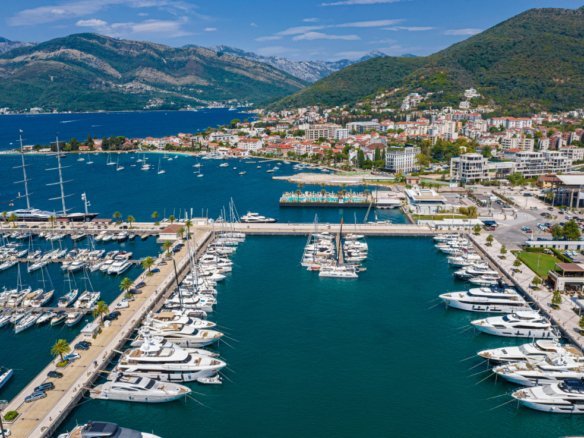
The Bay of Kotor, specifically Tivat and the Kotor area, has become the default choice for international buyers prioritising premium infrastructure and year-round amenability. Porto Montenegro in Tivat provides marina living, international schooling, and a resident community that functions regardless of season. For buyers seeking the most liquidity on resale and the strongest brand recognition, the Bay of Kotor is the benchmark. A detailed comparison is available in Barok Estates International’s analysis of Bay of Kotor versus Budva.
The Budva Riviera offers a different trade-off: stronger summer tourism demand, a wider range of price points, and a more established short-term rental market. Gross yields trend towards the higher end of the Montenegro range in well-positioned Budva properties, though buyer competition is also more intense at accessible price levels. The area guide for the Budva Riviera covers the submarket and its submarkets in detail.
Lustica Bay represents the most considered long-term play in Montenegro: a master-planned resort with phased delivery over many years, targeting the international buyer who values a curated environment and is comfortable with a longer development timeline. For buyers with a 5-plus year investment horizon and a preference for managed infrastructure over autonomous ownership, Lustica Bay is worth specific attention alongside the Lustica Bay property guide.
The EU Accession Factor
Montenegro’s EU accession process is a consistent part of the investment thesis being advanced for the country’s property market. It is worth being precise about what this means and what it does not.
Montenegro is the furthest advanced of any current candidate country in its EU accession negotiations. A 2028 target has been discussed at the political level. Accession, if it occurs, would not change the legal right of UK buyers to own property in Montenegro, which already exists under bilateral agreements. However, it would likely affect property values, particularly in premium coastal markets, by bringing Montenegro’s regulatory and institutional framework into closer alignment with EU standards and by opening the country to a wider pool of EU-buyer demand. That price effect, if it materialises, would benefit existing holders. It is not a certainty, and buyers should treat it as a potential upside rather than a structural guarantee.
A broader analysis of how accession could affect values is in Barok Estates International’s assessment of Montenegro’s EU accession trajectory.
Due Diligence Priorities for UK Buyers
The legal due diligence process in Montenegro requires specific attention to issues that do not arise in the same way in UK property transactions. Title verification through the Real Estate Cadastre, confirmation of construction legality and building permits, and review of any encumbrances or charges on the property are non-negotiable steps. Older or extended buildings in coastal areas sometimes carry legacy legalisation issues that affect both residence permit applications and eventual resale. An independent lawyer, not connected to the selling agent or developer, is essential.
For buyers considering whether Montenegro is a safe investment jurisdiction, the legal framework for foreign buyers is well-established and title disputes at the premium end of the market are uncommon when proper due diligence is followed. The risk profile is materially different from markets where foreign ownership rights are ambiguous or where title systems are unreliable.
Current Opportunities for UK Buyers
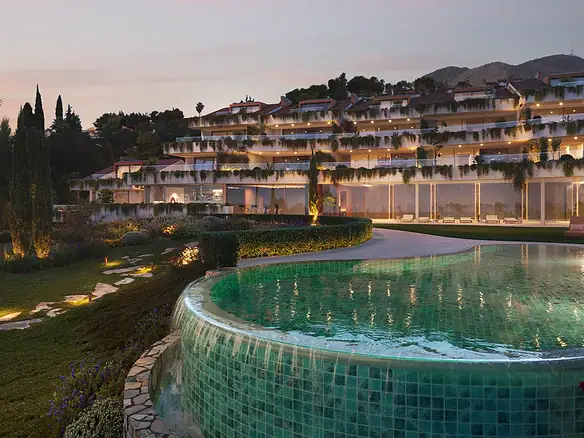
Barok Estates International currently advises on a curated selection of Montenegro coastal properties relevant to UK buyers across multiple price points. In Tivat, Boka Verde at Porto Montenegro offers premium marina residences at a considered entry point for the Porto Montenegro address. For buyers seeking ultra-luxury branded product, the Nikki Beach Penthouse in Tivat represents the top of the waterfront branded residence market in Montenegro. Across the Bay of Kotor, Horizon Sea View Residences provide contemporary specification at open bay positions.
Barok Estates International is a premium, multi-location real estate advisory operating across Europe and the Middle East.
Explore our Montenegro portfolio: barokestates.com/listings
For a confidential consultation on Montenegro acquisitions: barokestates.com/contact