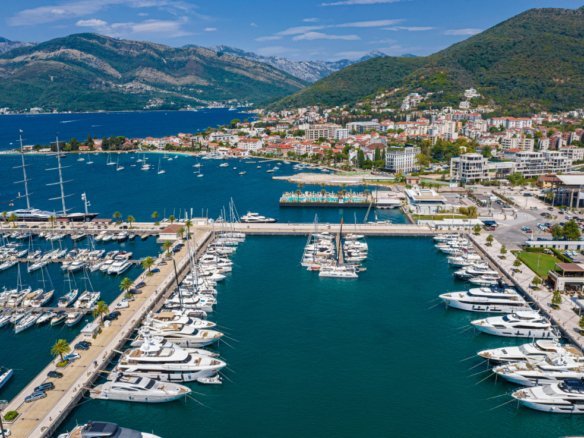
Montenegro real estate prices are still climbing in 2026, not at peak. EU accession momentum, supply constraints, and rising foreign demand continue to drive coastal property values higher. (see the Montenegro Statistical Office (MONSTAT))
Montenegro Real Estate 2026: Peak Pricing or Strategic Entry Window?
Montenegro’s property market has moved decisively beyond its early-growth phase. As a result, prices are now at historically elevated levels, yet the underlying drivers remain intact.
For sophisticated capital, the question is no longer whether Montenegro is “undervalued.”
The question is how to position correctly at this stage of the cycle.
Market Snapshot: Strong Growth, Shifting Dynamics
Furthermore, recent data confirms the momentum:
- Average new-build prices: ~€2,200 per sqm nationally, up ~19% year-on-year
- Coastal transaction volume: +20% since 2023
- Prime waterfront assets: 2–4x inland pricing
At the top end:
- Porto Montenegro: €6,000–€15,000 per sqm
- Luštica Bay: €4,000–€8,000 per sqm
- Portonovi: €2,000–€3,500 per sqm
Consequently, these are no longer “emerging market” price points.
They reflect a market transitioning into a recognized European luxury destination.
Central Bank Signals: Context, Not Alarm
Montenegro’s central bank has flagged prices as “historically high” relative to domestic income levels.
Admittedly, this is accurate, but incomplete.
A typical apartment now trades at roughly 11x average annual salary, placing Montenegro at the upper end of European benchmarks:
- Vienna: 8–9x
- Lisbon: 9–10x
- Barcelona: 10–11x
Importantly, this is not indicative of a speculative bubble.
It reflects a market where pricing is increasingly driven by international capital, not local purchasing power.
The real message is clear:
In other words, the easy growth phase is over. The strategic phase has begun.
What’s Driving the Market
1. Tourism as a Structural Anchor
Notably, tourism is no longer cyclical in Montenegro, it is structural.
As a result, international arrivals have expanded consistently, supported by:
- new airline routes
- infrastructure upgrades
- increasing global visibility
Therefore, this creates sustained demand not only for hospitality, but for residential, rental, and mixed-use property.
2. Foreign Capital Repositioning
Meanwhile, international buyers now dominate the prime segment.
In particular, in key coastal developments, foreign capital accounts for 60–70% of transactions, with strong activity from:
- GCC investors
- UK and EU buyers
- globally mobile HNW clients
Furthermore, EU accession progress has materially shifted perception, positioning Montenegro as a frontier European market with institutional upside. (see the European Commission’s enlargement page)
3. Scarcity of Prime Coastal Supply
At the same time, waterfront real estate in Montenegro is inherently limited.
Prime inventory is concentrated within a small number of institutional-grade developments, including:
- Porto Montenegro
- Luštica Bay
- Portonovi
Consequently, supply cannot expand at the same pace as demand.
This imbalance continues to support pricing resilience.
4. Pre-Accession Positioning
Similarly, new developments are increasingly aligned with EU regulatory standards ahead of accession.
This is creating a two-tier market:
- modern, compliant assets commanding premiums
- older stock requiring future upgrades
For this reason, from an advisory perspective this distinction is becoming critical.
Where Pricing Stands Today
Stretched Segments
Selective caution is warranted in:
- secondary coastal areas without strong infrastructure
- generic “luxury” developments lacking brand or platform credibility
- inland markets driven primarily by domestic demand
These segments have benefited from market momentum, but lack the same structural support.
Fair Value Segments
By contrast, prime developments remain defensible despite higher entry points:
- Porto Montenegro
- Luštica Bay
These assets offer:
- institutional-grade management
- international recognition
- long-term positioning
Pricing is elevated, but aligned with quality and scarcity.
Strategic Entry Opportunities
More selective opportunities exist in:
- heritage properties in Kotor and Perast
- secondary coastal areas benefiting from infrastructure expansion
- income-focused assets outside prime luxury segments
These require a clearer investment thesis, but can offer strong relative value.
Yield Reality
At current price levels:
- Prime developments: ~3–4% gross yield
- Coastal mid-market: ~4–5%
- Inland income assets: ~5–7%
Ultimately, yield alone is not the primary driver.
The market is mainly a capital appreciation and positioning play, particularly linked to EU accession.
Timing the Cycle
The most relevant factor is not current pricing, but timing within the cycle.
A realistic trajectory:
- 2026: Elevated pricing, moderate growth (5–10%)
- Pre-accession phase: increased capital inflow
- Accession window: potential for accelerated appreciation
- Post-accession: normalization toward European benchmarks
In summary, the critical window is not behind the market.
It is still forming.
Strategic Approach to Deployment
At this stage, disciplined positioning is essential.
From an advisory perspective, the focus should be on:
- clarity of thesis
capital appreciation vs. income generation - asset quality over entry price
scarcity and platform strength matter more than discounts - measured negotiation
flexibility exists, particularly off-market - legal precision
local due diligence remains critical - capital discipline
avoid overexposure to a single segment or narrative
Risk Factors
Key variables to monitor include:
- EU accession timing
- macroeconomic conditions in source markets
- interest rate environment
- regulatory shifts
These do not invalidate the thesis.
They reinforce the need for selective execution.
Conclusion: Expensive, but Strategically Relevant
Above all, Montenegro is no longer an undiscovered market.
Pricing reflects that.
However, the structural drivers remain intact:
- tourism expansion
- foreign capital inflows
- supply constraints
- EU integration trajectory
For well-positioned capital, the opportunity is not “cheap entry.”
It is early alignment with a market transitioning into maturity.
At Barok Estates, our approach is not volume-driven.
It is based on identifying where pricing is justified, where positioning is strategic, and where long-term value is preserved.
In this phase of the cycle, discipline matters more than timing.
And strategy matters more than momentum.
Barok Estates International provides expert guidance for buyers and investors seeking premium real estate. Explore our current portfolio or contact our team to learn more.