
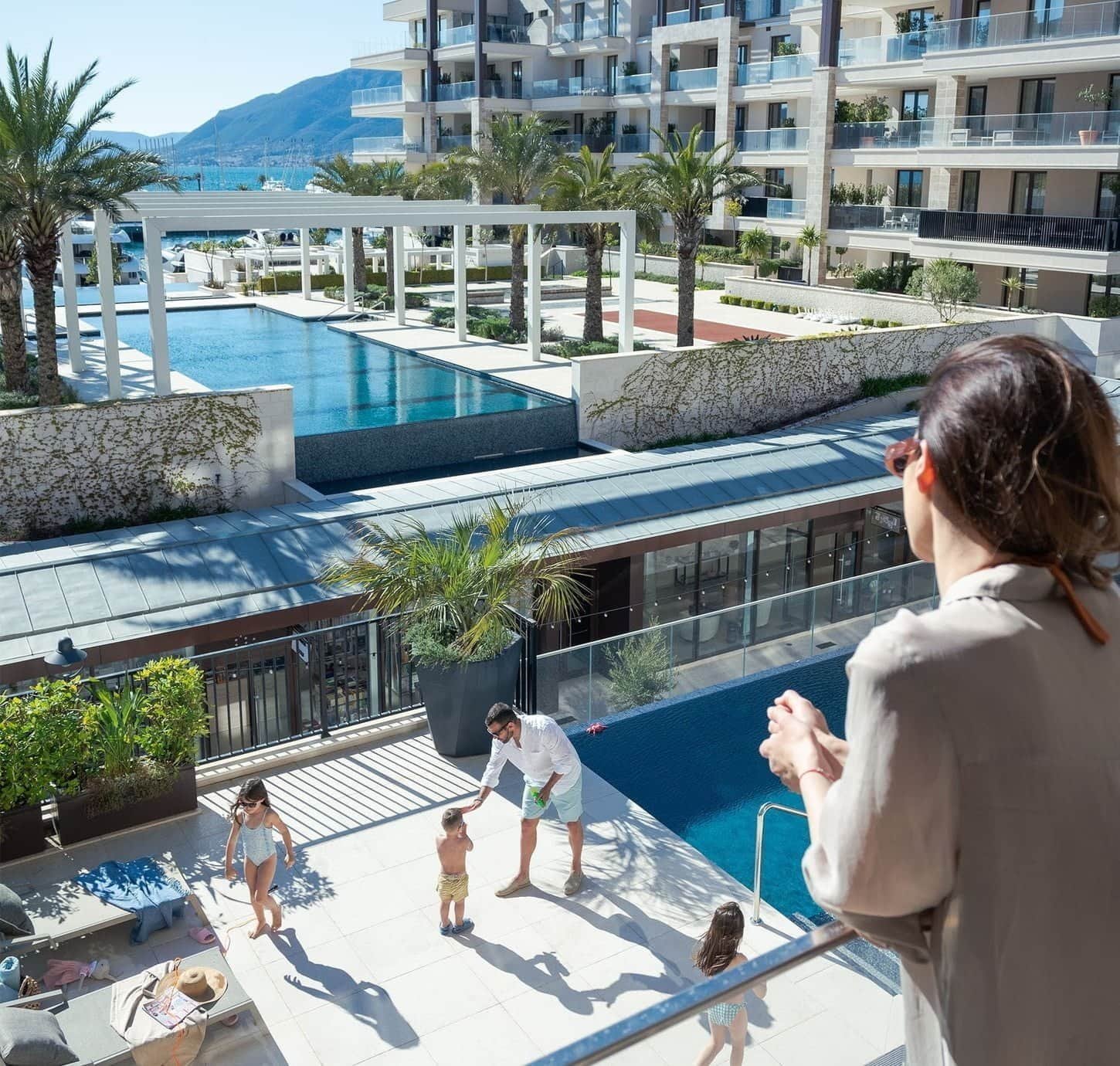
Consequently, tL;DR: Porto Montenegro residents consistently highlight the quality of community life, the safe environment, and the genuine social connections formed within the marina development as key reasons for choosing Tivat. (see the Montenegro Statistical Office (MONSTAT))
Developers market community. What they mean, typically, is a curated selection of shared amenities and a promise of congenial neighbours. What community actually requires is something harder to manufacture: the accumulation of shared experience, the informal social networks that develop through proximity over time. And the kind of institutional fabric, clubs, schools, events, local commerce, that gives people reason to stay and invest their time in a place. Porto Montenegro, now more than a decade into its development. Has moved beyond the marketing phase of community and into something that deserves closer examination.
An International Resident Community
Therefore, porto Montenegro’s resident community is unusually international, even by the standards of European marina developments. Residents from the United Kingdom, Russia, the Gulf states, France, Germany. Italy and the broader post-Soviet world have settled alongside a growing contingent of digital nomads and semi-nomadic professionals who maintain multiple residences across Europe. The community’s international character is not incidental, it is a consequence of Montenegro’s strategic positioning as a neutral. Relatively low-tax jurisdiction within the Adriatic that has attracted internationally mobile capital since independence in 2006. (see PwC’s international tax summaries)
As a result, for residents, the practical consequence is a social environment. That is genuinely cosmopolitan without the homogeneity that afflicts some expat-heavy locations. People arrive with different backgrounds, professional contexts and cultural references, and the marina environment. Where social interaction is structured around shared activities rather than shared nationality, tends to produce connections that are substantive rather than merely convenient.
Meanwhile, the permanent resident population is supplemented by a significant seasonal and semi-permanent cohort, particularly in the summer months when yacht owners. Their crews and extended families add density and energy to the marina community. This seasonal influx, which might appear to dilute community cohesion. In practice reinforces it: the rhythm of arrival and departure creates anticipation and reunion in cycles that many residents describe as one of the more enjoyable aspects of marina life.

Events, Culture and Social Infrastructure
In addition, the social calendar at Porto Montenegro is more substantial than the development’s scale might suggest. Porto Montenegro Yacht Club hosts a programme of racing events, sundowner gatherings, prize-givings and seasonal parties that provide the backbone of a shared social calendar. The marina promenade hosts outdoor events including markets, live music and cultural programming, particularly during summer. Local restaurants and the marina’s hospitality offer provide venues for the kind of informal regular socialising. That defines community quality more accurately than formal events alone.
For this reason, the broader Bay of Kotor region contributes cultural depth that Porto Montenegro’s own programming cannot replicate. The Kotor Summer Carnival, the Boka Night naval procession and the town of Kotor’s UNESCO-listed old town provide cultural touchpoints that give residents reason to engage with the wider region. Integrating Porto Montenegro into a historical and cultural landscape rather than existing as an enclave apart from it.
However, barok Estates International advises clients on exactly this type of strategic positioning.
Moreover, the development’s hospitality infrastructure, including the Regent Porto Montenegro hotel, restaurants, retail and spa. Provides a consistent level of service that supports social events and visiting guests without residents needing to leave the marina environment. This integration of hotel-quality hospitality within a residential community is a model. That has proven effective at comparable developments including Porto Cervo, Antibes and the Algarve.
The Marina as a Town Centre
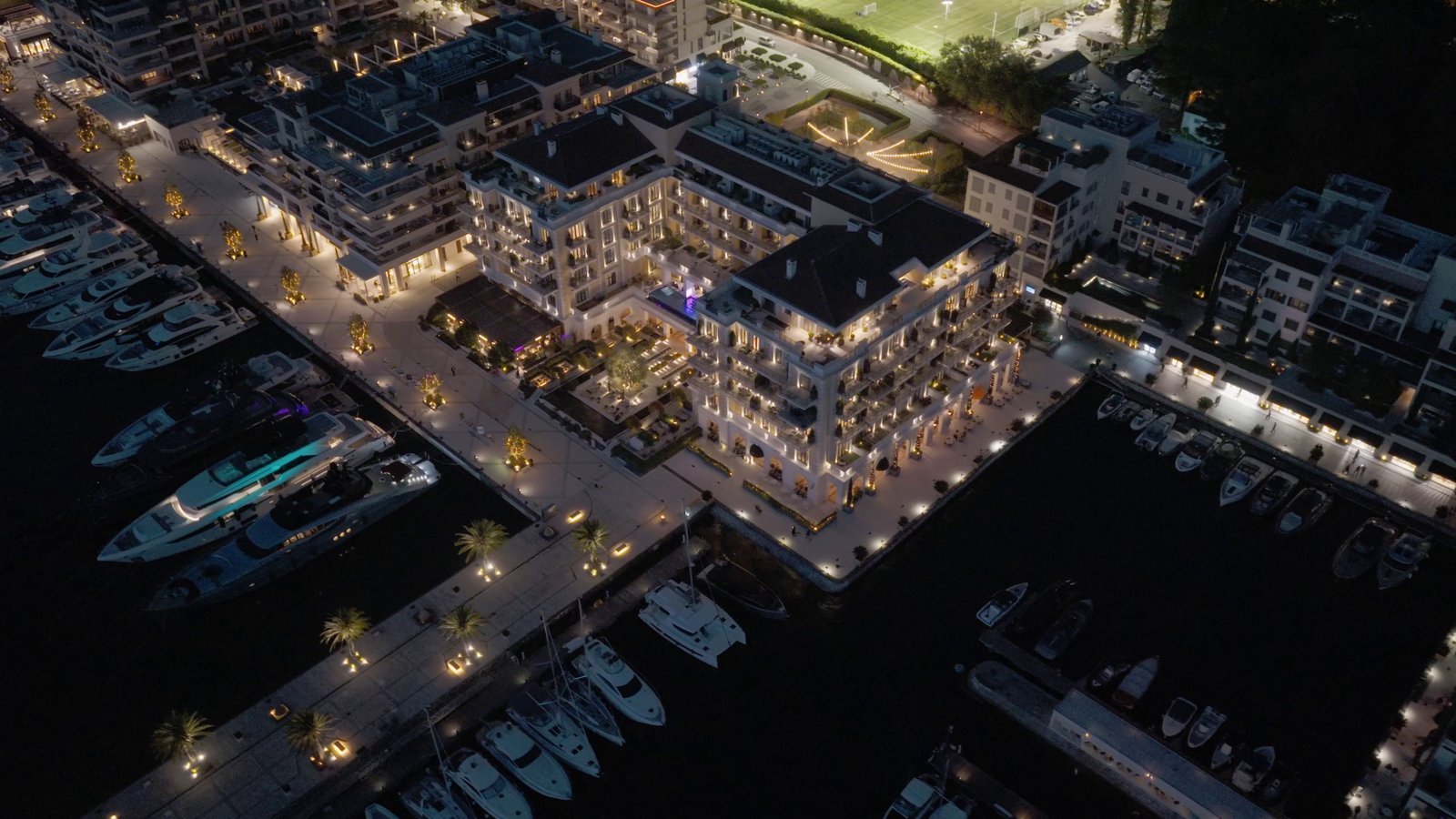
Furthermore, one of the more perceptive observations from long-term residents is that the marina promenade functions. In practice, as a town centre rather than a leisure amenity. People go there to meet, to walk, to see and be seen, to eat and drink, to buy provisions and to observe the boats. This is what a functioning public space does, and the fact that Porto Montenegro’s central space serves this function. Rather than existing as an underused backdrop to apartments, is significant.
Notably, the walking economy of the marina supports a range of small businesses: a pharmacy. A specialist food retailer, barbers, coffee shops and wine bars that serve residents rather than tourists. This distinction matters because businesses serving residents have different opening hours, pricing structures and service standards than tourist-oriented establishments. And their presence is a reliable indicator of the quality of permanent community that has developed. Residents report being on first-name terms with marina staff, restaurant owners and neighbouring boat crews in a way that speaks to the social texture of a genuinely lived-in place.
At the same time, for those exploring residency options, the waterfront residences at Porto Montenegro offer direct access to this social environment, with the marina promenade within minutes’ walk of all residential buildings. The broader context for property buyers in Montenegro is well covered in the Montenegro real estate guide, which addresses the structural factors that underpin the market.
Community as a Value Proposition for Buyers
By contrast, the financial case for community quality in residential property is straightforward. But often underweighted by buyers focused on yields or capital appreciation metrics. Developments with strong community cohesion, measured by occupancy rates, resident retention, the vitality of local commerce and the calibre of social infrastructure. Outperform comparable developments without these qualities over medium and long time horizons. This is not a soft observation; it is supported by transaction data from comparable marina developments across the Mediterranean.
For example, this is the kind of market dynamic that Barok Estates monitors closely for its UHNW clientele.
Porto Montenegro’s community has developed organically over more than a decade. Which means it is not a projection or a promise. Prospective buyers can visit, observe and engage with the community before committing, and most who do find that the social environment exceeds their expectations. Which is the inverse of the experience at many new-build resort developments where the marketing outpaces the reality.
In Summary
Community at Porto Montenegro is not a developer’s aspiration, it is an observable reality, built over time by the residents. Institutions and commercial operators who have chosen to invest their time and capital in the place. For buyers for whom the quality of daily social life matters alongside the physical environment. And investment case, it warrants close attention.
Barok Estates International provides expert guidance for buyers and investors seeking premium real estate. Explore our current portfolio or contact our team to learn more.