
Budva has been luring visitors since the ancient Greeks founded a trading settlement on its rocky promontory. Two and a half thousand years later, the formula has not changed: a walled old city perched above a brilliant sea, beaches of unusual quality within walking distance, and an appetite for life after dark that the rest of Montenegro politely declines to match. For the international traveller who wants Adriatic authenticity alongside genuine energy, Budva is the address.
This is the guide our team at Barok Estates gives to clients who want to understand Montenegro’s most storied coastal town, whether they are visiting for the first time or considering it as a base for property.
Budva Old Town: Two and a Half Millennia in Limestone
The Stari Grad, Budva’s old town, is the most immediately compelling piece of urban theatre on the Montenegrin coast. A compact ensemble of medieval churches, baroque palaces, cobblestone alleys, and Venetian-era walls, it juts into the Adriatic on its own small peninsula with the quiet confidence of something that has survived everything history could arrange.
Walk the walls for a few euros and the scale of the place becomes clear: the old town is genuinely small, perhaps 15 minutes at a stroll from one end to the other, which means its density of churches, galleries, hidden courtyards, and konobas is extraordinary. Every alley contains something worth pausing for. The Church of the Holy Trinity, the Catholic Cathedral of St John, and the Orthodox Church of Saint Ivan cluster within a few hundred metres of each other, a reminder that Budva has always been a crossroads town.
The Dancing Girl statue on the seafront promenade just outside the walls is Budva’s most photographed landmark, a bronze figure that has become the image the town exports most readily. The photograph with the old town behind her is, admittedly, a very good photograph.
The City Walls: Worth Every Cent
Comparisons with Dubrovnik are inevitable and not entirely unfair. Budva’s walls are smaller and less dramatic, but they are also a fraction of the price to walk, the queues are shorter, and the sea views are, in their own quieter register, equally beautiful. In our experience advising buyers across Montenegro, Budva’s old town is the place that most reliably produces the response: “I had no idea this existed.”
The Beaches of Budva
Budva’s beaches are among the most varied on the Montenegro coast, ranging from the broad public stretch of Slovenska Plaža, with its kilometre and a half of promenade, beach bars, and reliable summer energy, to the more intimate coves that require a little more determination to reach.
Mogren Beach is the one that earns its reputation. Accessed via a short cliff path from the old town, through a tunnel cut in the rock, it opens onto two sandy sections divided by a rugged headland. The approach, with the Adriatic visible through the rock and the old town walls visible above, is genuinely dramatic. It is the kind of beach that rewards the five extra minutes of effort with a location that feels earned.
Jaz Beach, a few kilometres west of the old town, is where Budva’s summer crowds go when they want space and volume. The beach itself is wide and handsome, the bars are loud, and the energy in July and August is Adriatic at full speed. It has hosted international music festivals in recent years, with lineups that have included artists from across the electronic and mainstream spectrum.
Pizana and Ričardova Glava
For those who prefer their beaches without the crowds, the smaller stretches of Pizana and Ričardova Glava, tucked against the old town walls themselves, offer proximity to the Stari Grad combined with a scale that keeps the numbers manageable. Early mornings here, with the walls above and the water below and the town not yet fully awake, are among the better arguments for arriving in Budva before the summer peak.
Sveti Stefan: Budva’s Most Iconic Neighbour
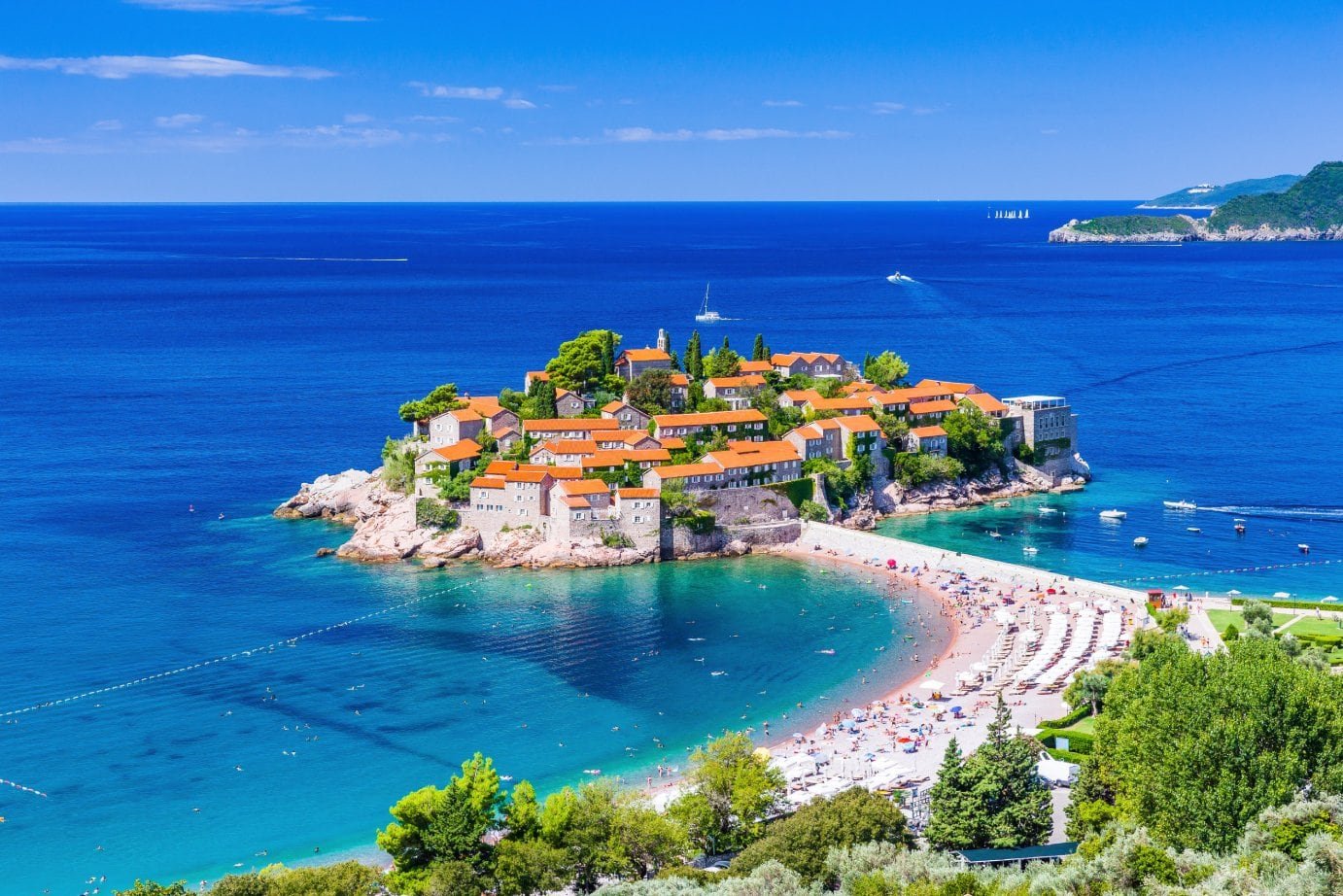
A 15-minute drive south of Budva, Sveti Stefan is the image Montenegro has used to introduce itself to the world for decades. The 15th-century island village, connected to the mainland by a narrow sand causeway, rises from the Adriatic in a way that suggests it was designed specifically to be photographed. It was not, of course. It was built as a fortified fishing community and has spent the last half-century as one of the most celebrated hotel addresses on the Mediterranean.
Aman Sveti Stefan occupies almost the entire island, its 50-odd stone cottages and suites restored to a standard that the original residents would find baffling and the current clientele finds perfectly appropriate. Queen’s Beach, at the base of the causeway, is among the most beautiful beaches in the entire country: a crescent of pale sand framed by the island on one side and the pine forests of Villa Milocer on the other. Villa Milocer itself, a 1930s summer palace once owned by Queen Marija of Serbia, forms the mainland component of the Aman estate and operates year-round.
The island portion of the resort reopens fully in summer 2026 following an extended closure, which makes this the ideal moment to plan a visit. Day access to the beach, with sunbed hire, is available to non-residents, and the approach drive from Budva, winding along a clifftop road above the sea, is exceptional in its own right.
Budva’s Nightlife: The Real Thing
Budva’s reputation as the Adriatic’s premier nightlife destination is not marketing. It is a straightforward description of what happens here in summer. The clubs on the cliffs above the town, principally Top Hill and Omnia, operate at a scale and with a frequency of international bookings that would not embarrass Ibiza. The music leans heavily toward electronic and Balkan pop, the nights run until dawn, and the energy is genuine rather than manufactured.
Those who prefer their evenings at a lower volume will find the old town’s bars and restaurants entirely satisfying. The alleys of the Stari Grad fill after dinner with a mix of locals, regional visitors, and international travellers who discovered that watching the candlelit stone of Budva old town at night, with a glass of Vranac and nowhere specific to be, is a very good use of an evening.
Torch Beach Club, on the seafront, offers the daytime beach party variant: music, sun, and the particular combination of indolence and sociability that the Adriatic summer exists to provide.
Dining in Budva
The food in Budva runs the full range, from tourist traps on the main promenade to exceptional fresh seafood at waterside konobas that take no reservations and close when the fish runs out. The Stari Grad’s alleys contain a higher density of the latter than their small size suggests.
La Mar on the seafront has established itself as one of the better formal dining options in the town. Ribarsko Selo in nearby Sveti Stefan specialises in grilled catch served with the directness that Montenegrin fish restaurants do best. For those who want to understand the local culinary tradition, the places to look for are the ones without English-language menus in the window: the konobas that serve mussels from the Bay of Kotor, octopus under peka, and the Njeguški prosciutto that is as close to a national delicacy as Montenegro has.
Budva vs. Tivat: The Question Buyers Ask
In our experience advising buyers across Montenegro, the Budva versus Tivat question comes up consistently, and it is worth addressing directly. Budva offers historical depth, beach variety, and a social energy that Tivat does not attempt to match. Tivat offers Porto Montenegro’s marina infrastructure, a quieter daily pace, and a community of international residents that is, by Montenegro’s standards, well-established.
Buyers with families, or those looking for year-round residency rather than a summer base, tend to find the Tivat proposition more compelling. Those drawn primarily by lifestyle energy, by the old town atmosphere, the beach variety, and the summer intensity, often find Budva the more persuasive case. Both markets have delivered strong capital appreciation over recent years, and both form part of Barok Estates’ core coverage area.
What neither market offers is the feeling of having missed something. Montenegro’s coast is small enough that Budva and Tivat are both within easy reach of each other, and the buyers who choose one invariably spend time at the other. The question is not either/or. It is which one you want to wake up in.
Talk to Barok Estates About Budva and the Montenegro Coast
Barok Estates is Montenegro’s specialist in luxury and lifestyle property, with on-the-ground expertise that covers Budva, Sveti Stefan, Tivat, and the full length of the Adriatic coast. We have been guiding international buyers through this market long enough to know which properties perform, which locations are evolving, and which deals represent genuine value.
If Budva is on your radar, whether for a holiday home, a rental investment, or a permanent base, explore our Montenegro real estate listings and our detailed guides to buying property in Montenegro. Or reach out directly. The best decisions in this market are made by people who have walked the streets, sat on the beaches, and understood what they are actually buying. We are here to make that process straightforward.