
Montenegro punches well above its weight. A country the size of Connecticut holds one of the most dramatic coastlines in Europe, two UNESCO World Heritage Sites, five national parks, and a wine culture that has been fermenting since the Venetians were in charge. For the discerning international traveller who has already sensed that the great Mediterranean alternatives still exist, this small Adriatic nation delivers in ways that far larger, far more expensive destinations simply cannot.
Our team at Barok Estates has spent years guiding international buyers through Montenegro, and the question we hear most often is not about prices or paperwork. It is: what is life actually like here? This is our answer.
The Bay of Kotor: Europe’s Most Dramatic Inlet
The Bay of Kotor is the entry point for most visitors, and rightly so. From the air, or from the deck of a superyacht, it reads as pure theatre: limestone mountains plunging into deep blue water, medieval village after medieval village strung along the shoreline like jewels on a chain.
Kotor’s old town is the obvious starting point. The UNESCO-listed walls date from the 9th century, and the climb to St John’s Fortress at sunrise remains one of the most unashamedly beautiful things you can do on the entire Adriatic. At the top, with the bay spread out beneath you in morning silence, it becomes very easy to understand why our clients consistently tell us that Montenegro’s quality of life was what sealed their decision to buy here.
Perast, a short drive along the bay from Kotor, deserves an afternoon at minimum. The 17th-century palaces that line its waterfront are impeccably preserved, and a short boat ride brings you to Our Lady of the Rocks, a man-made island and baroque church that has been accumulating votive offerings and sailors’ prayers for three centuries. The boatmen who ferry visitors across are unhurried and direct, and will tell you the history without embellishment. This is Montenegro at its most authentic.
Kotor Bay Mussels: A Culinary Detail Worth Knowing
The inner bay’s clean, cold waters produce mussels that rank among the finest in Europe. You will find them at virtually every waterfront konoba, steamed with white wine and local herbs, or folded into a risotto that bears no resemblance to anything you will encounter in a tourist trap. In our experience advising buyers across Montenegro, the quality of everyday eating is one of the most consistently remarked-upon pleasures of life here.
Budva and the Riviera
South of the bay, the coast opens into the Budva Riviera, Montenegro’s most visited stretch of shoreline and the country’s undisputed hub of summer energy. Budva’s old town, a compact walled city of pre-Roman origin, rises directly from the Adriatic with a confidence that Dubrovnik inspires with more tourist infrastructure but considerably less intimacy. Walk the city walls for a few euros and you will understand why comparisons to its more famous neighbour are so often made, and why Budva, in many respects, wins on atmosphere.
Mogren Beach, reached via a short cliff path from the old town, is one of the most photographed stretches of sand in the country. Jaz Beach, a few kilometres west, is where the crowds gather in July and August, where the beach bars are louder and the energy is Mediterranean at full volume.
For those seeking something quieter, Sveti Stefan stands a short drive south. This 15th-century island village, connected to the mainland by a narrow causeway, is home to Aman Sveti Stefan, one of the most celebrated resort hotels in the world. The beach at its base, Queen’s Beach, frames the island in a way that photographers have been attempting to capture justly for decades. Villa Milocer, the 1930s royal summer palace that forms part of the Aman estate, adds further historical texture to what is already an exceptional stretch of coast. The island portion of the resort reopens fully in summer 2026 after extended closure, making this the ideal year to plan a visit.
Durmitor and the Northern Mountains
Montenegro’s interior rewards travellers willing to look away from the coast. Durmitor National Park, a UNESCO World Heritage Site, is organised around a high plateau of glacial lakes and peaks exceeding 2,500 metres. In summer it is prime territory for hiking, mountain biking, and the sort of dramatic panoramas that remind you how much of Europe has been over-developed.
Skiing in Kolašin: Montenegro’s Mountain Resort
For winter visitors, the answer is Kolašin, Montenegro’s premier ski destination and one of the most underrated ski towns in the Balkans. The resort operates across two interconnected areas: Kolašin 1450 and Kolašin 1600, together offering 45 kilometres of groomed pistes ranging from beginner greens to challenging black runs, served by ten modern lifts including high-speed gondolas and six-seater chairs. The season runs mid-December to early April, with conditions typically at their best through January and March.
What distinguishes Kolašin from more established Alpine alternatives is the combination of uncrowded slopes, competitive lift pass pricing, and a town that has retained genuine Montenegrin character. Equipment rental, a ski school, and a children’s beginner area are all in place. The resort has international competition credentials and expansion plans that will take total skiable terrain to 60 kilometres in the near term, with long-term ambitions to become the largest resort in Southeast Europe. For buyers considering Montenegro as a year-round base rather than a summer property, Kolašin answers the question of what winter looks like.
The Tara River Canyon, which cuts through the park, is the deepest canyon in Europe and the second deepest in the world after the Grand Canyon. White-water rafting on the Tara is among the finest such experiences on the continent, with multi-day trips camping on the riverbanks available for those who want to take it seriously. Zip-lining across the canyon is available for those whose commitment to altitude is more theoretical.
Biogradska Gora, a smaller and far less visited national park in the central region, protects one of Europe’s last areas of virgin temperate rainforest. The glacial lake at its centre, surrounded by ancient trees some 500 years old, is genuinely primordial. Very few travel articles mention it. That is, in itself, a recommendation.
Cetinje and Montenegro’s Royal History
No account of things to do in Montenegro is complete without Cetinje, the country’s former royal capital set in a mountain basin at 670 metres above sea level. In size it is modest. In historical density it is remarkable.
The National Museum of Montenegro encompasses the former royal palace, the King Nikola Museum, and the History Museum. Together they document a country that, for all its small size, maintained its independence against the Ottoman Empire for centuries and produced a royal family whose descendants married into the courts of Russia, Italy, and Serbia. The Cetinje Monastery, housing what is said to be the hand of St John the Baptist, draws pilgrims from across the Orthodox world.
The drive from Kotor up the old serpentine road to Cetinje is one of the most dramatic mountain drives in Europe: 25 hairpin bends rising some 900 metres above the bay. At the summit of Mount Lovćen, the mausoleum of Prince-Bishop Petar II Petrović-Njegoš, Montenegro’s national poet, commands views that on clear days extend to Italy. Lovćen National Park, which surrounds the peak, is considered the spiritual heartland of the country.
The Food, the Wine, and the Konoba
Montenegro’s culinary tradition divides cleanly between coast and interior. Along the Adriatic, the emphasis falls on grilled fish, Kotor Bay mussels, and octopus prepared under a peka, a domed iron lid buried in embers. Move inland and the plates shift to slow-cooked lamb, wild game, and the smoked prosciutto and mountain cheese from Njeguši village, the highland settlement that produced Montenegro’s royal family and some of its most prized cured meats.
The wine culture centres on Vranac, an indigenous red grape that produces a full-bodied, deeply coloured wine with high tannins and considerable structure. The Plantaže winery outside Podgorica is the largest single-owner vineyard in Europe and offers tours and tastings. Boutique producers around Lake Skadar, particularly in the villages of Virpazar, Godinje, and Rvaši, run family cellars where the wine is poured without ceremony and the conversation is genuine. For a property buyer considering Montenegro as a place to live rather than merely to visit, these wine roads are a significant part of the proposition.
Krstač, the indigenous white grape, pairs beautifully with the coast’s seafood and is worth seeking out. The annual Wine and Bleak festival in Virpazar, held in late spring, draws visitors from across the region and is a useful introduction to the country’s vineyards.
Water, Adventure, and the Lake
Montenegro’s position between mountain and sea creates unusual opportunities for water-based adventure. Kayaking the Bay of Kotor, with its 28 kilometres of navigable inner water, is an excellent day. Guided tours depart from Kotor, Perast, and Tivat, covering the bay’s quieter inlets and stopping at waterside restaurants accessible only by boat.
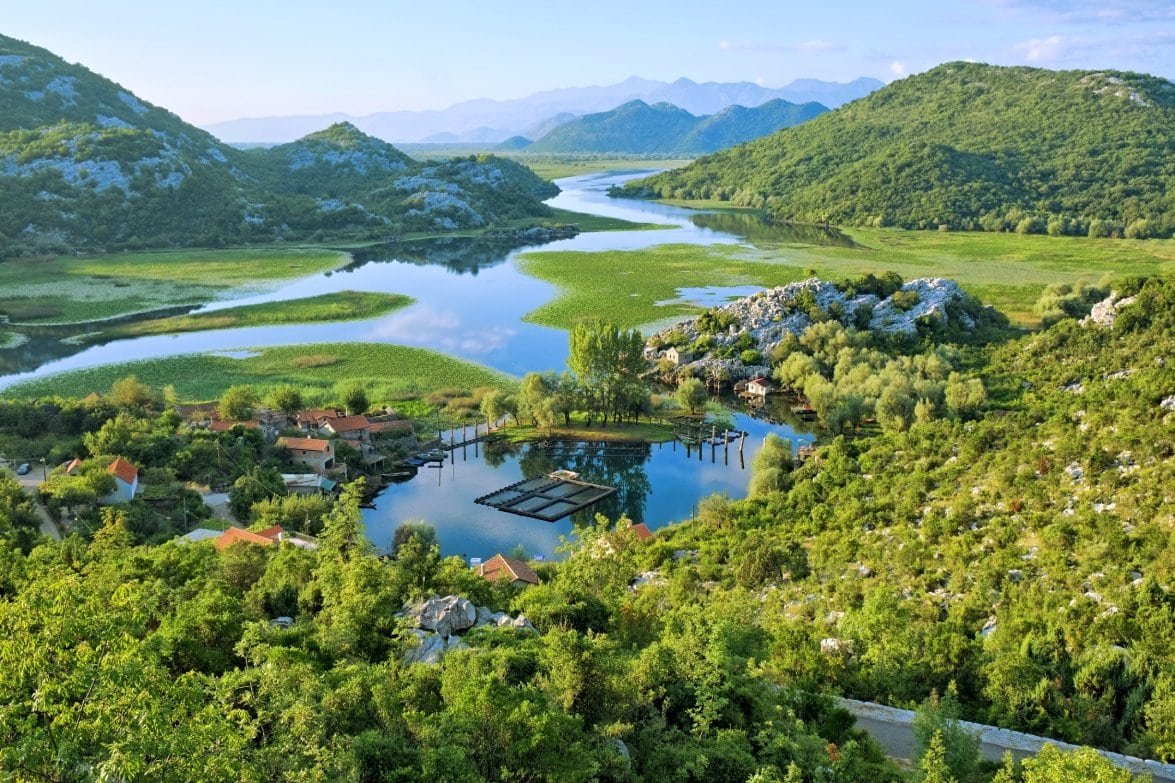
Lake Skadar, the largest lake in the Balkans, is a different proposition entirely: a vast expanse of reeds, pelicans, and medieval ruins rising from the water. Boat trips from Virpazar take in the lake’s extraordinary bird life, its wine villages, and the remains of Ottoman fortresses that once controlled the surrounding territory. It is peaceful in a way that is increasingly rare in coastal Europe.
Ostrog Monastery, built improbably into a sheer white cliff face above the Zeta River valley, is one of the most visited sites in the entire country, attracting some 100,000 pilgrims and visitors annually. The approach road alone, a series of steep switchbacks through pine forest, is an experience. The monastery itself, with its two cave churches fused directly into the rock, is extraordinary.
Discovering Montenegro Through Property
Barok Estates has been guiding international buyers through Montenegro’s property market for years, and the lifestyle dimension is consistently as persuasive as the financial one. EU candidate status, a favourable tax environment, year-round accessibility from European capitals, and a cost of living that remains well below comparable Mediterranean destinations make the practical case straightforward.
The experiential case is what this guide has attempted to make. A morning climbing the walls of Kotor, an afternoon tasting Vranac at a lakeside cellar, an evening watching the lights of the bay from a terrace above Tivat. This is not a tourism product packaged for consumption. It is a way of life that a small number of international buyers have already discovered, and that a growing number are in the process of discovering now.
Talk to Barok Estates
If Montenegro has captured your attention, whether for a first visit or a first property, Barok Estates is the team that knows this market from the inside. We work exclusively in Montenegro’s luxury and lifestyle segment, with expertise spanning the Bay of Kotor, Tivat, Budva, and the entire Adriatic coast.
Explore our full portfolio at Montenegro real estate, or discover the Bay of Kotor coastal lifestyle in depth. When you are ready to move beyond the guide and into the market, we are here.