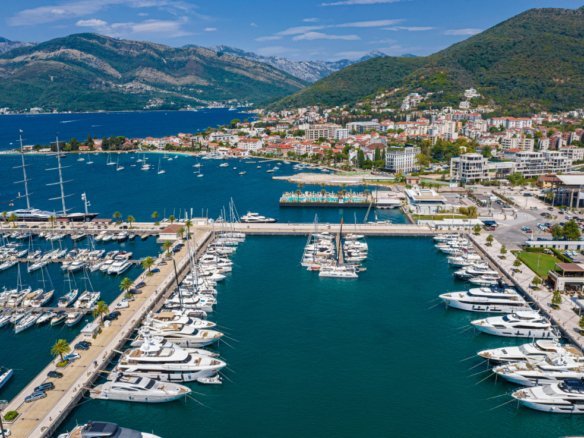

Kotor Bay is one of Europe’s most dramatic natural landscapes — a flooded river canyon carved deep into the Montenegrin mountains, its shoreline lined with medieval villages, Venetian fortifications, and some of the Adriatic’s most sought-after real estate. For international buyers, the Bay of Kotor represents a different proposition entirely from the resort-driven Budva Riviera: quieter, more architectural, and increasingly positioned at the premium end of the Montenegro market.
This guide covers the bay’s distinct communities, from the UNESCO-listed city of Kotor to the village of Bijela, and examines what the property market here means for buyers in 2026.
The Bay of Kotor: Geography and Character
Kotor Bay is not a single bay but a succession of interconnected inlets — the outer bay (Herceg Novi to Tivat) and the inner bay, where the walls close in and the water takes on an almost fjord-like stillness. The result is a microclimate that is cooler and more humid than the open Adriatic coast, with lush vegetation descending to the waterline and views that shift constantly as you move around the shore.
The bay encompasses a remarkable concentration of historic settlements: Herceg Novi at the entrance, Tivat (home to Porto Montenegro), Perast, Risan, Prčanj, Dobrota, Bijela, and — at the innermost point — the city of Kotor itself. Each has its own character, its own architecture, and its own property market dynamics.
What unites them is the sense of place. Kotor Bay moves at a different pace from Budva. The buyers it attracts tend to be more established, often seeking a permanent or semi-permanent base rather than a purely investment-driven purchase.
Kotor Old Town: A UNESCO World Heritage City
The city of Kotor — Kotor city proper — sits at the apex of the inner bay, its medieval walls climbing the sheer face of Mount Lovćen above. The old town is one of the finest preserved Venetian-era cities in the Adriatic, a labyrinth of palaces, churches, squares, and stone-flagged streets that has changed little in 500 years.
UNESCO World Heritage status, conferred in 1979, brings both recognition and restriction. Development within the city walls is tightly controlled, which suppresses supply and underpins long-term value. Properties in the city of Kotor old town range from compact one-bedroom apartments in restored palaces to multi-floor townhouses with private courtyards — all finished in the honey-grey stone that defines the Adriatic vernacular.
Prices within the old walls range from €2,500 to €5,000+ per square metre, with exceptional properties commanding premiums beyond that range. Demand from buyers across Western Europe, Russia, the Gulf, and North America has remained consistent through varying market cycles, reflecting the irreplaceable character of what is on offer.
Outside the walls but within walking distance — the Dobrota waterfront and Prčanj — prices are lower and supply is somewhat more available, with a mix of older apartments and new boutique developments overlooking the bay.
Perast and Risan: The Quieter Shore
Perast, on the northern shore of the inner bay, is among Montenegro’s most beautiful villages — a Baroque gem of patrician palaces and church towers, fronted by two small islands (Our Lady of the Rocks and St George) that have become the country’s most photographed tableau.
Risan Montenegro, a few kilometres further west, is less visited and less polished — and for buyers who want the bay experience without the Perast premium, that is precisely the appeal. Risan has Roman roots (the mosaic floors of a Roman villa are on display in the town) and a genuine working-village character that Perast, which is now almost entirely given over to tourism in season, has somewhat lost.
Property in both settlements is characterised by old stone buildings that require investment, interspersed with occasional new-build or fully renovated properties. Buyers here are typically buying a project as much as a product — and the returns for those who invest well in Perast in particular have been substantial.
Bijela: The Bay’s Emerging Quarter
Bijela Montenegro sits on the outer bay, between Herceg Novi and Tivat, and represents one of the most interesting emerging opportunities on the entire Kotor Bay shoreline. Historically a shipyard town, Bijela has benefited from significant investment in its waterfront and from overspill demand from the Porto Montenegro development in Tivat.
A marina development and residential project in Bijela has attracted considerable attention from buyers priced out of Porto Montenegro but seeking comparable waterfront access and amenities. Prices remain meaningfully lower than Tivat or Kotor, and the infrastructure trajectory is upward — making Bijela a compelling option for buyers with a medium-term horizon.
Sveti Stefan: The Luxury Benchmark
Strictly speaking, Sveti Stefan Montenegro falls within the Budva Riviera municipality rather than Kotor Bay — but its gravitational pull on the wider premium market is undeniable. The Aman Sveti Stefan resort, occupying the entire historic island village, has positioned Montenegro firmly at the top of the Adriatic luxury hospitality spectrum.
For Kotor Bay buyers, Sveti Stefan functions as a reference point: it demonstrates the ceiling of what the Montenegro market can achieve, it attracts the calibre of visitor who subsequently considers buying, and it sets the tone for how premium Montenegrin properties are presented to a global audience.
Kotor Bay Property Market: What International Buyers Should Know
The Kotor Bay property market differs from Budva in several important respects:
Lower volume, higher distinctiveness. The bay does not have Budva’s volume of transactions, but what trades tends to be more architecturally distinctive and more tightly held. Properties in Perast and Kotor Old Town rarely appear on the open market — they circulate within networks of agents with genuine local relationships.
Renovation-led value creation. A significant proportion of bay-side stock is older buildings in various states of repair. Buyers who understand construction costs and have the appetite to manage a renovation project can acquire at a substantial discount to finished-property values. The upside for well-executed renovations in Kotor Old Town and Perast is unrivalled anywhere in Montenegro.
Long-term hold bias. Bay buyers tend to hold longer. The asset class suits those building a legacy holding rather than seeking near-term liquidity. Short-term rental performance is strong in season — Kotor attracts significant cruise tourism — but the primary driver for most buyers is capital preservation and personal use.
Porto Montenegro premium. The Tivat end of the bay, anchored by Porto Montenegro marina, operates at a distinct price level: €3,000–€6,000 per square metre for branded marina residences. This development has been transformative for the entire bay’s international profile and continues to attract buyers from the super-yacht world.
Why International Buyers Choose Kotor Bay
The Bay of Kotor draws a specific kind of international buyer — one who has typically already explored Dubrovnik, the Amalfi Coast, and the Greek islands, and is looking for something that combines comparable beauty with a significantly lower entry price and a less crowded ownership market.
Montenegro’s visa-free access for most Western and Gulf nationals, its euro-denominated economy, and its low property transaction costs (typically 3–5% in total) make the mechanics straightforward. The cultural richness of the bay — its Venetian heritage, its Orthodox monasteries, its UNESCO recognition — provides the depth that genuinely satisfies buyers looking for more than a beach apartment.
Montenegro’s ongoing EU accession process provides an additional structural tailwind. As the country’s institutions and legal frameworks continue to align with European standards, the confidence of international buyers in the property ownership process increases proportionately.
For buyers considering retirement or semi-retirement on the bay, our guide to retiring in Montenegro covers residency options, healthcare access, and the practicalities of long-term living in detail. For a full breakdown of Kotor-area pricing and developments, the Kotor real estate property guide is the right starting point.
Barok Estates has deep roots in the Kotor Bay market. If you are ready to explore what the bay has to offer — from a waterfront apartment in Dobrota to a palazzo project in Perast — contact us for expert guidance built on unrivalled local knowledge.